
Exercises after knee replacement are crucial for your successful recovery and return to an active lifestyle. Here’s what you need to know:
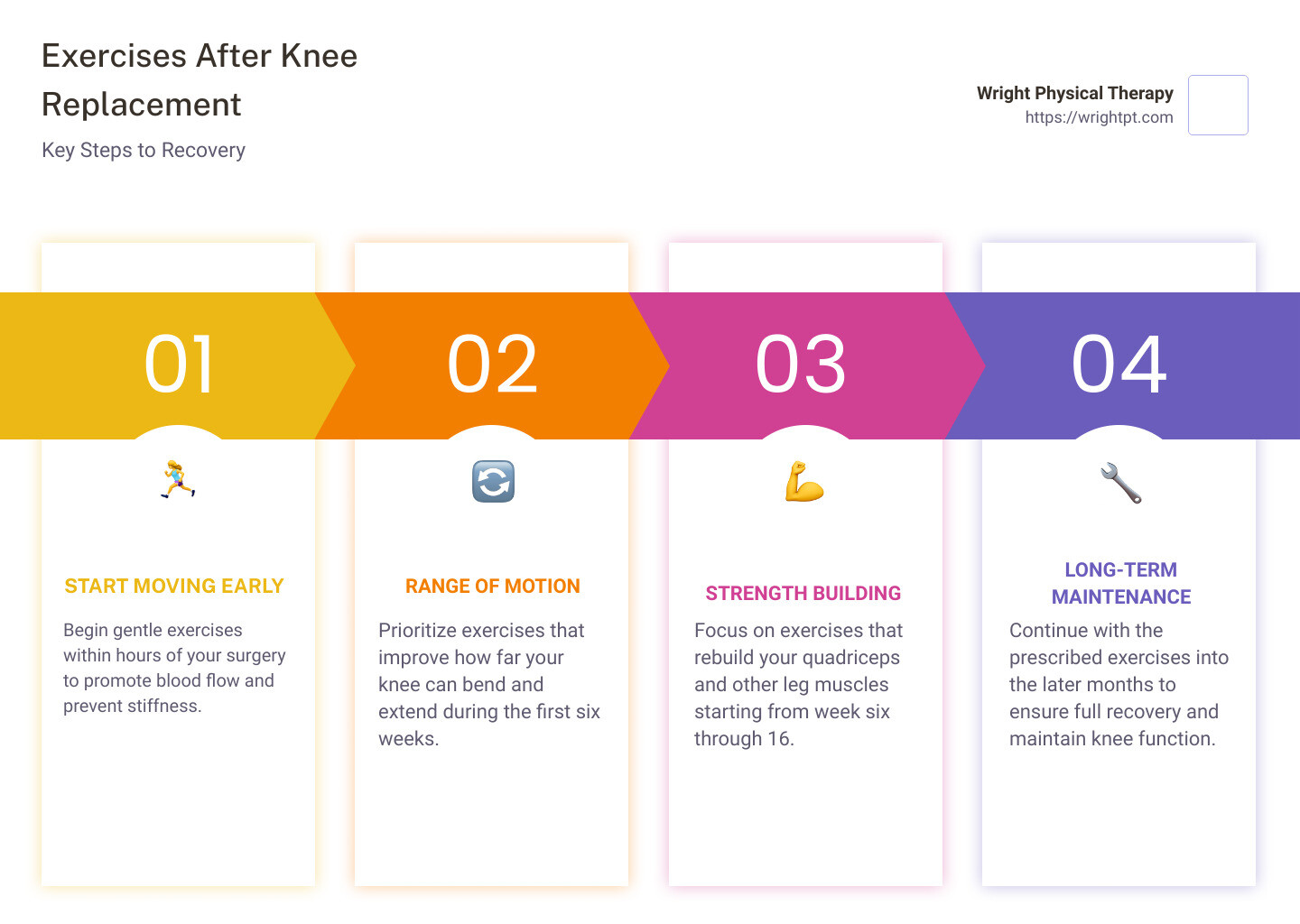
- Start Moving Early: Begin gentle exercises within hours of your surgery.
- Range of Motion: Prioritize exercises that improve how far your knee can bend and extend during the first six weeks.
- Strength Building: Focus on exercises that rebuild your quadriceps and other leg muscles starting from week six through 16.
- Long-Term Maintenance: Continue with the prescribed exercises into the later months to ensure full recovery.
At Wright Physical Therapy, we understand that knee replacement surgery is a significant life event, and getting back on your feet requires the right guidance and support. Rehabilitation is essential not just for healing, but for regaining strength, flexibility, and overall function.
My name is Bryan Wright, and with a commitment to reducing suffering and promoting joyful living, I have helped numerous individuals through tailored, high-skilled physical therapy treatment. I aim to empower you with the knowledge and exercises necessary for a smooth and effective recovery.
Early Post-operative Exercises
Starting your rehabilitation journey with early post-operative exercises is crucial for a successful recovery. These exercises help reduce swelling, improve blood circulation, and gradually increase your knee’s range of motion. Let’s dive into some key exercises you can do right from your bed or chair.
Quadriceps Sets
Quadriceps sets are a simple yet effective way to activate and strengthen your thigh muscles. Here’s how to do them:
- Lie on your back and tighten the muscles in one thigh.
- Try to straighten the knee. Hold for 5–10 seconds.
- Repeat 10 times within a 2-minute period. Rest for 1 minute and then repeat.
- Switch to the other leg once the thigh feels tired.
Straight Leg Raises
Straight leg raises help to strengthen your quadriceps without putting too much strain on your knee.
- Lie back and straighten your leg.
- Tighten the thigh muscles and lift the leg several inches off the bed.
- Hold for 5–10 seconds and then slowly lower the leg.
- Repeat until the thigh feels tired.

Ankle Pumps
Ankle pumps are great for improving circulation and reducing swelling.
- Lying on your back, move your foot up and down while keeping the leg straight.
- Do this for 2–3 minutes, 2–3 times an hour.
Knee Straightening Exercises
Knee straightening exercises help you regain full extension, which is vital for walking and other activities.
- Sit on a sturdy chair with your lower leg on an equal height chair or solid surface in front of you.
- Relax your muscles to let your knee straighten.
- Hold for 5 to 10 minutes. You should feel a gentle stretch on the back of your knee.
You can also do this stretch lying on your bed with a rolled-up blanket or towel under your ankle.
Bed-supported Knee Bends
Bed-supported knee bends help improve knee flexion.
- While lying down, bend one knee and slide the foot toward the buttocks, keeping the heel on the bed.
- Slowly bend the knee as far as possible, then hold for 5–10 seconds.
- Slide the foot back down, straightening the leg.
- Repeat until the leg feels tired.
Sitting Supported Knee Bends
This exercise is excellent for improving knee motion while providing support.
- Sit on the bedside or in a chair, ensuring the thighs have support.
- Cross the ankles, putting the foot of the unoperated leg behind the other, with the legs out straight.
- Slowly bend the knee as much as possible. Hold for 5–10 seconds.
- Repeat several times until the leg feels tired.
Sitting Unsupported Knee Bends
Once you’re comfortable with the supported knee bends, you can move to unsupported ones.
- Sit toward the front of a sturdy chair.
- Bend your knee by slowly sliding your foot back-and-forth, resting briefly as needed.
- Try to move your foot back farther each time.
- Hold for 20 to 30 seconds. Return to the starting position and relax. Repeat 3 times.
These early post-operative exercises set the foundation for a successful recovery. Up next, we’ll discuss the importance of walking and early activity in your rehabilitation journey.
Walking and Early Activity
Walking is one of the best exercises after knee replacement. It helps you regain strength and mobility in your new joint. Here’s how to do it right:
Proper Walking Technique
- Stand comfortably with your weight evenly balanced.
- Advance your walker or crutches a short distance.
- Reach forward with your operated leg, keeping your knee straight. Your heel should touch the floor first.
- As you move forward, let your knee and ankle bend so your entire foot rests flat on the floor.
- Complete the step by lifting your toe off the floor and bending your knee and hip for the next step.
Tip: Walk rhythmically and smoothly. Don’t hurry. Adjust your step length and speed as necessary.
Walker or Crutches
Initially, you’ll use a walker or crutches to help with balance and weight-bearing. Your surgeon or therapist will guide you on how much weight to put on your leg.
- Week 1-2: Use a walker or crutches.
- Week 3-4: Transition to a single crutch or cane when you can walk and stand for more than 10 minutes without carrying weight on the walker or crutches.
Note: Hold the cane in the hand opposite to your operated leg.
Weight-Bearing Instructions
Your doctor will tell you how much weight you can put on your leg:
- Partial Weight Bearing: Only a portion of your weight on the operated leg.
- Full Weight Bearing: Gradually place more weight on your leg as you gain strength and balance.
Stair Climbing and Descending
Climbing stairs is excellent for strengthening and improving flexibility. Here’s how to do it safely:
- Use a handrail for support.
- Going Up: Lead with your unoperated leg.
- Going Down: Lead with your operated leg.
- Take each step one at a time: Ascend with one leg, then bring the other up to the same level.
Tip: Have someone nearby for support until you regain strength.
Statistics: Studies show that 95% of patients have no problem climbing stairs after a successful recovery from knee replacement surgery.
Early Activity
Soon after surgery, you’ll begin walking short distances in your hospital room and performing everyday activities. This early activity aids recovery and helps your knee regain strength and movement.
- Stand comfortably with your weight evenly balanced.
- Advance your walker or crutches a short distance.
- Reach forward with your operated leg, keeping your knee straightened so the heel of your foot touches the floor first.
- As you move forward, your knee and ankle will bend and your entire foot will rest evenly on the floor.
- As you complete the step, your toe will lift off the floor and your knee and hip will bend so that you can reach forward for your next step.
These steps will help you on your path to recovery. Next, we’ll dive into advanced exercises and activities to further enhance your rehabilitation.
Advanced Exercises and Activities
Once you’ve regained some independence and can walk short distances, it’s time to step up your rehabilitation game. Advanced exercises and activities are crucial for building strength, improving mobility, and ensuring a full recovery. Here are some key exercises to focus on:
Standing Knee Bends
Standing knee bends are excellent for improving knee flexibility and strength. To do this exercise:
- Stand behind a sturdy chair or a counter for support.
- Slowly bend your knee, bringing your heel toward your buttocks.
- Hold for 5-10 seconds.
- Slowly lower your foot back to the floor.
Repeat this until your leg feels tired. This exercise helps to stretch and strengthen the muscles around your knee.
Resistance Exercises
Resistance exercises can significantly boost your muscle strength. These usually start 4 to 6 weeks post-surgery. You can use light ankle weights (1-2 pounds) to begin with. Here are a couple of resistance exercises to try:
- Leg lifts with weights: Attach the weights to your ankles and perform straight leg raises as you did in the early stages but with added resistance.
- Seated knee extensions: Sit on a chair, attach weights to your ankles, and straighten your knee. Hold for 5 seconds and then slowly lower your leg.
Gradually increase the weight as your strength improves.
Exercycling
Riding an exercise bike is an excellent way to regain muscle strength and knee mobility. Here’s how to get started:
- Adjust the seat height so that the bottom of your foot just touches the pedal with your knee almost straight.
- Start by pedaling backwards. This is usually easier and helps to get your knee used to the motion.
- Once comfortable, begin pedaling forwards.
- Slowly increase the tension on the bike as you become stronger.
Aim to exercise for 10-15 minutes, twice a day, and gradually build up to 20-30 minutes, 3-4 times a week.
Pain or Swelling Management
It’s normal to experience some pain and swelling after exercise. Here are some tips to manage it:
- Elevate your leg: Prop your leg up with pillows when resting.
- Ice your knee: Apply ice wrapped in a towel for 20 minutes, then remove it for 20 minutes. Repeat this cycle for about 2 hours if needed.
- Listen to your body: If you experience sharp pain, stop the activity and consult your physical therapist or doctor.
Managing pain and swelling effectively will help you stay on track with your rehabilitation.
These advanced exercises and activities are designed to help you fully recover and get back to doing the things you love. Next, we’ll discuss strengthening and stretching exercises to further enhance your recovery.
Strengthening and Stretching Exercises
Strengthening and stretching exercises are crucial for a successful recovery after knee replacement surgery. They help improve your knee’s range of motion, build muscle strength, and reduce stiffness. Let’s dive into some key exercises.
Quadriceps Strengthening
Strengthening your quadriceps (the large muscles on the front of your thigh) is essential for knee stability.
Lying Kicks (Short Arc Quadriceps)
1. Lie on your back with a rolled-up blanket or towel under your surgical knee.
2. Straighten your surgical leg and hold for 5 seconds.
3. Slowly lower your leg and relax.
4. Keep the back of your knee in contact with the blanket or towel throughout the exercise.
Sitting Kicks (Long Arc Quadriceps)
1. Sit on a sturdy chair or the edge of your bed.
2. Straighten your knee and hold for 5 seconds.
3. Slowly lower your leg and relax.
Thigh Squeezes (Quadriceps Sets)
1. Tighten the muscles on the top of your thigh by pushing the back of your knee down into the bed.
2. Hold for 5 seconds and relax.
Hamstring Stretching
Stretching your hamstrings (the muscles at the back of your thigh) helps alleviate tightness and improves flexibility.
Supine Figure Four
1. Lie on your back with your knees bent and feet on the floor.
2. Place your right shin across your left thigh in a figure-four position.
3. Flex your right foot and gently press your right knee away from you.
4. Hold for 10 breaths, then switch sides.
Hamstring Stretch
1. Lie flat on your back with your non-surgical leg bent and foot flat on the floor.
2. Clasp your hands behind your thigh and straighten your surgical leg toward the ceiling.
3. Hold for a few seconds and then relax.
Calf Stretch
Stretching your calf muscles helps improve ankle flexibility and supports your knee.
Standing Calf Stretch
1. Stand facing a wall with your hands on the wall for support.
2. Step back with your surgical leg, keeping it straight and your heel on the ground.
3. Bend your front knee and lean forward until you feel a stretch in your calf.
4. Hold for 20-30 seconds, then switch legs.
Step Stretch
Step stretches help improve your knee’s range of motion and strength.
Knee Step-Up
1. Stand in front of a step or low platform.
2. Step up with your surgical leg, then bring your non-surgical leg up.
3. Step back down with your non-surgical leg, followed by your surgical leg.
4. Repeat 10 times.
Knee Step-Up
This exercise strengthens your quadriceps and improves knee stability.
Knee Step-Up
1. Stand in front of a step or low platform.
2. Step up with your surgical leg, then bring your non-surgical leg up.
3. Step back down with your non-surgical leg, followed by your surgical leg.
4. Repeat 10 times.
By incorporating these strengthening and stretching exercises into your routine, you’ll enhance your recovery and get back to your daily activities more quickly. Next, we’ll explore cardiovascular exercises to further support your rehabilitation.
Cardiovascular Exercises
Cardiovascular exercises are crucial for improving your overall fitness and aiding in your recovery after knee replacement surgery. These exercises help increase blood flow, reduce stiffness, and boost your mood. Here are some of the best options:
Cycling
Cycling is one of the most recommended exercises after knee replacement. You can start with a stationary bike as early as two weeks post-surgery. Cycling helps improve knee flexibility and strength without putting too much stress on the joint.
- Begin with short sessions: Start with 5-10 minutes and gradually increase the duration.
- Adjust the seat height: Make sure your knee is only slightly bent at the bottom of the pedal stroke.
- Low resistance: Keep the resistance low initially to avoid straining your knee.
Swimming
Swimming and water-based exercises are excellent for knee rehabilitation. The buoyancy of water reduces stress on your knee while providing resistance to help strengthen muscles.
- Start with gentle swimming: Activities like walking in the pool or doing gentle strokes can be beneficial.
- Water walking: Simply walking in waist-deep water can be a great start.
- Aqua aerobics: Joining a class can provide structured exercises tailored for recovery.
Elliptical Machine
The elliptical machine offers a low-impact way to get your heart rate up while protecting your knee.
- Proper form: Ensure you maintain an upright posture and use the handles for balance.
- Moderate resistance: Start with low resistance and gradually increase as your strength improves.
- Short sessions: Begin with 10-15 minutes and slowly build up to longer sessions.
Treadmill Walking
Treadmill walking allows you to control the pace and incline, making it a versatile option for recovery.
- Flat surface: Start with walking on a flat surface to avoid unnecessary strain.
- Slow pace: Keep a slow and steady pace, focusing on proper walking technique.
- Incline: Gradually introduce a slight incline as your strength and confidence grow.
Group Exercise Classes
Joining group exercise classes can provide motivation and support during your recovery. Look for classes specifically designed for individuals recovering from surgery.
- Low-impact classes: Classes like yoga, Pilates, or water aerobics are excellent choices.
- Tailored programs: Some gyms offer classes specifically for joint replacement recovery.
- Community support: Being part of a group can keep you motivated and make exercising more enjoyable.
Incorporating these cardiovascular exercises into your routine will help you regain your strength and mobility. Always consult with your physical therapist before starting any new exercise to ensure it’s safe for your specific condition.
Next, we’ll address some frequently asked questions about exercises after knee replacement to help you stay informed and on track with your recovery.
Frequently Asked Questions about Exercises After Knee Replacement
How long should you do exercises after a knee replacement?
Duration and frequency are crucial for effective recovery. In the days following your surgery, exercises should be short—around 15 to 20 minutes per session. As you progress, this can be increased gradually. Typically, patients are encouraged to exercise for 20–30 minutes a day, combined with walking for 30 minutes 2–3 times a day.
Consistency is key. Follow the guidance of your physical therapist to ensure you’re not overdoing it. Over-exercising can strain your new knee and slow down recovery.
What is the best exercise machine after knee replacement?
When it comes to the best exercise machines post-surgery, three options stand out:
-
Stationary Bike: This is often recommended as early as two weeks post-operation. It helps improve knee mobility and strength without putting too much stress on the joint.
-
Elliptical Machine: This is a great low-impact option that combines cardiovascular exercise with muscle strengthening. It’s generally safe to start using an elliptical around 12 weeks post-surgery, but always check with your therapist first.
-
Treadmill: Walking on a treadmill can be beneficial, but it’s essential to start slow. Use a flat incline initially and gradually increase the duration and speed as your knee gets stronger.
How many times a day should I exercise after total knee replacement?
Frequency is just as important as duration. In the first few days, aim for short exercise sessions 2–3 times a day. This can include simple movements like ankle pumps and quadriceps sets.
As you recover, your physical therapist may recommend increasing the frequency to 3–4 times a day. This could include a mix of exercises like straight leg raises, sitting-supported knee bends, and short walks.
Incorporating walking into your daily routine is essential. Start with short walks, gradually increasing the distance and duration as you gain strength and confidence.
By following these guidelines and consulting with your physical therapist, you can ensure a smooth and effective recovery.
Next, let’s delve into the importance of consistency and long-term recovery strategies to maintain your new knee’s health and functionality.
Conclusion
Consistency is key to a successful recovery after knee replacement surgery. Regularly performing your exercises after knee replacement helps ensure that your knee heals properly, regains strength, and achieves the best possible range of motion.
Long-term recovery is just as important as the early stages. By the third month, you might feel about 75% recovered, but the final 25% happens over the next six to twelve months. According to Vincent Luppino, PT, DPT, OCS, “The last six to 12 months are when you really fully recover, so don’t give up on the program too early.” This means continuing your prescribed exercise routine and gradually incorporating other activities like cycling, swimming, or even gym workouts as advised by your physical therapist.
At Wright Physical Therapy, we are dedicated to guiding you through every phase of your recovery. Our personalized treatment plans are designed to help you regain strength, flexibility, and confidence. By working closely with our expert team, you can navigate your rehabilitation journey effectively and get back to enjoying your daily activities.
Ready to take the next step in your recovery? Contact Wright Physical Therapy today to schedule an appointment with one of our experienced physical therapists. Your path to recovery starts here.