

Relieve and Rebuild: Top Knee Rehab Exercises
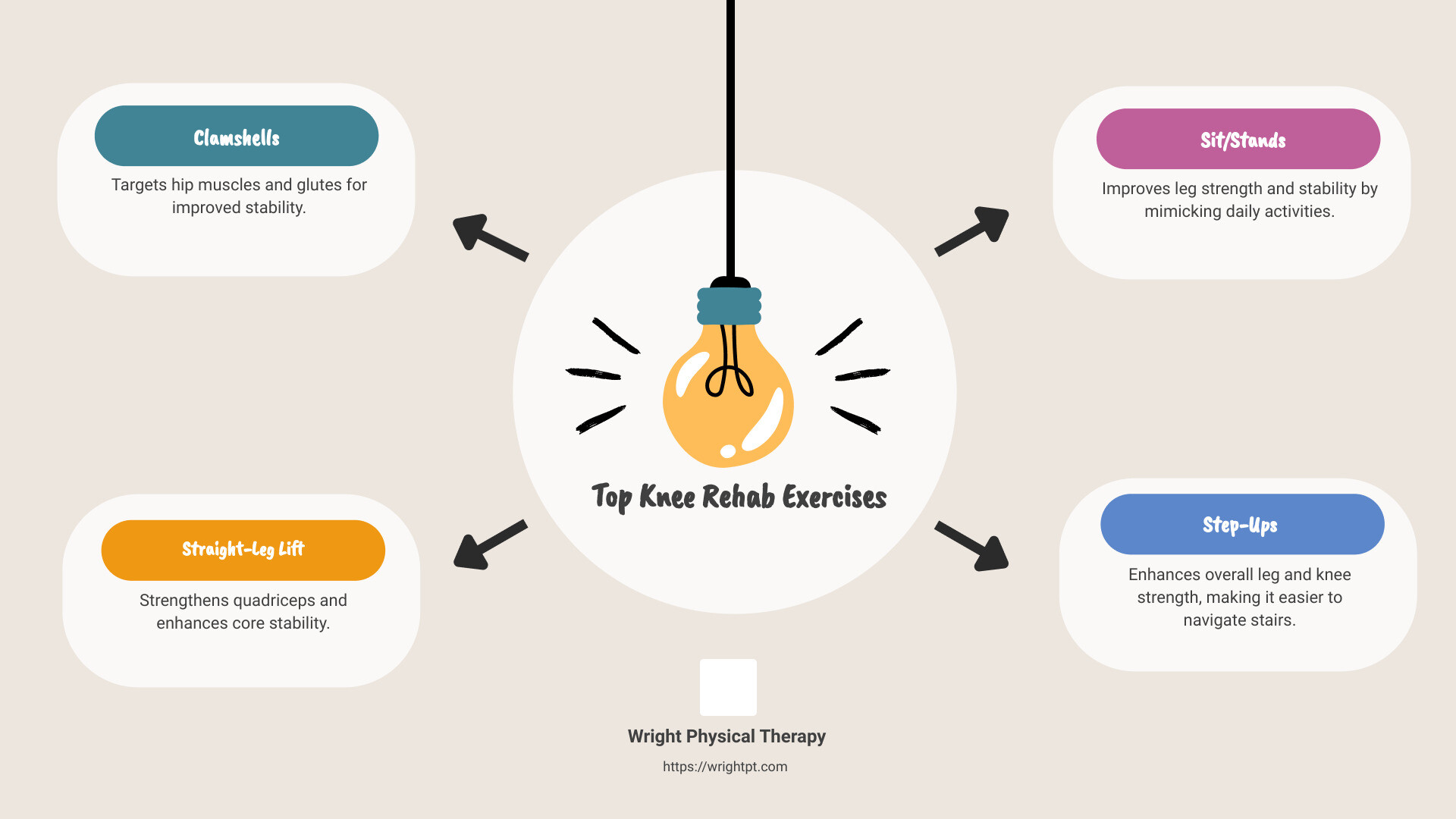
Knee rehab exercises are essential for anyone recovering from a knee injury or surgery. They help you regain strength, flexibility, and function in your knee joint. If you’re dealing with knee pain or an injury, start with these effective exercises:
- Clamshells: Targets hip muscles and glutes
- Straight-Leg Lift: Strengthens quadriceps and core stability
- Sit/Stands: Improves leg strength and stability
- Step-Ups: Enhances overall leg and knee strength
- Glute Bridges: Focuses on glutes, hamstrings, and core stability
Always consult your doctor or physical therapist before starting any rehab program to ensure these exercises are suitable for your condition.
Knee pain is incredibly common, given that the knee is one of the largest and most complex joints in your body. Daily activities like walking and using stairs can place significant stress on your knees, leading to pain or discomfort. Physical therapy is a life-changing option that can help you return to an active, healthy lifestyle without the need for dangerous drugs or invasive surgeries.
I’m Bryan Wright, and my aim is to help you find joy and alleviate suffering through effective physical therapy. With my expertise in knee rehab exercises, you can count on personalized and high-quality care to get back to doing what you love.
Dive into our detailed guide to learn more about these exercises and how they can help you.
Understanding Knee Anatomy and Function
The knee is one of the largest and most complex joints in your body. Understanding its anatomy and function is crucial for effective rehabilitation and preventing further injury.
Knee Joint
The knee joint is a hinge joint, meaning it primarily allows for bending and straightening motions. It connects the thigh bone (femur) to the shin bone (tibia). The knee also includes the smaller bone that runs alongside the tibia (fibula) and the kneecap (patella).
Bones
- Femur: The thigh bone is the longest and strongest bone in your body.
- Tibia: The shin bone bears most of the weight.
- Fibula: This thinner bone runs parallel to the tibia.
- Patella: The kneecap protects the knee joint.
Ligaments
Ligaments are strong, fibrous tissues that connect bones to other bones. The knee has four main ligaments:
- Anterior Cruciate Ligament (ACL): Prevents the tibia from sliding out in front of the femur.
- Posterior Cruciate Ligament (PCL): Prevents the tibia from sliding backward under the femur.
- Medial Collateral Ligament (MCL): Provides stability to the inner knee.
- Lateral Collateral Ligament (LCL): Provides stability to the outer knee.
Tendons
Tendons connect muscles to bones. The most important tendon in the knee is the patellar tendon, which connects the quadriceps muscle to the tibia. This tendon is crucial for activities like jumping and running.
Cartilage
Cartilage in the knee includes the meniscus and articular cartilage:
- Meniscus: Two C-shaped pieces of cartilage act as shock absorbers between the femur and tibia.
- Articular Cartilage: Smooth tissue covers the ends of bones, allowing them to glide smoothly against each other.

Understanding these components helps you appreciate the complexity of the knee and the importance of targeted knee rehab exercises. This knowledge will guide you through exercises that aim to strengthen and protect these vital structures.
Next, we’ll dive into the Top 10 Knee Rehab Exercises that can help you regain strength, flexibility, and function.
Top 10 Knee Rehab Exercises
Rebuilding knee strength and flexibility is crucial for recovery. Here are the Top 10 Knee Rehab Exercises that focus on strengthening, stretching, and improving range of motion.
1. Half Squat
Muscles Worked: Hamstrings, quadriceps, glutes
How to Do It:
– Stand with feet shoulder-width apart.
– Bend your knees slightly, keeping your back straight.
– Lower your body until your knees are at about a 45-degree angle.
– Hold for a moment, then return to standing.
Tip: Keep your weight on your heels to protect your knees.
2. Calf Raises
Muscles Worked: Calf muscles
How to Do It:
– Stand facing a wall for balance.
– Lift your heels off the ground and stand on your toes.
– Hold for 5-10 seconds, then slowly lower back down.
Tip: This exercise helps improve balance and stability.
3. Hamstring Curl
Muscles Worked: Hamstrings
How to Do It:
– Attach a resistance band to a stationary object and your ankle.
– Stand facing the object and bend your knee, bringing your heel towards your buttocks.
– Hold for a moment, then lower back down.
Tip: Keep your back straight and avoid arching.
4. Leg Extensions
Muscles Worked: Quadriceps
How to Do It:
– Sit on a chair with your feet flat on the ground.
– Straighten your affected leg until it is parallel to the floor.
– Hold for 5-10 seconds, then slowly lower it back down.
Tip: This exercise helps improve knee extension strength.
5. Straight Leg Raises
Muscles Worked: Quadriceps, core
How to Do It:
– Lie on your back with one knee bent and the other leg straight.
– Lift the straight leg to the height of the bent knee.
– Hold for a moment, then lower it back down.
Tip: Tighten your thigh muscles to protect your knee.
6. Side Leg Raises
Muscles Worked: Hip abductors, glutes
How to Do It:
– Lie on your side with your legs stacked.
– Lift the top leg straight up, keeping it in line with your body.
– Hold for a moment, then lower it back down.
Tip: This exercise helps with lateral knee stability.
7. Prone Leg Raises
Muscles Worked: Hamstrings, glutes
How to Do It:
– Lie on your stomach with your legs straight.
– Lift one leg up without bending the knee.
– Hold for a moment, then lower it back down.
Tip: Keep your hips level to avoid strain.
8. Clamshells
Muscles Worked: Hip muscles, glutes
How to Do It:
– Lie on your side with knees bent and feet together.
– Open your top knee as far as possible without moving your pelvis.
– Hold for a moment, then lower it back down.
Tip: Use a resistance band for added difficulty.
9. Glute Bridges
Muscles Worked: Glutes, hamstrings, core
How to Do It:
– Lie on your back with knees bent and feet flat on the ground.
– Lift your hips towards the ceiling, squeezing your glutes.
– Hold for a moment, then lower back down.
Tip: This exercise also strengthens your core.
10. Wall Sits
Muscles Worked: Quadriceps
How to Do It:
– Stand with your back against a wall and feet shoulder-width apart.
– Slide down until your knees are at a 90-degree angle.
– Hold this position as long as possible.
Tip: Keep your back flat against the wall to maintain proper form.
These exercises are designed to help you regain strength, flexibility, and function in your knees. Remember to start slowly and gradually increase intensity as you progress.
Next, let’s explore Stretching Exercises for Knee Flexibility to further enhance your recovery.
1. Half Squat
Half squats are fantastic for strengthening the muscles around your knee, including your hamstrings, quadriceps, glutes, and hip muscles. This exercise can help improve stability and reduce the stress on your knee joint.
How to Do It:
- Stand with feet shoulder-width apart. You can rest your hands on the front of your thighs or reach them in front of you for balance. If needed, hold onto the back of a chair or a wall.
- Lower your hips about 10 inches. Imagine you are sitting down into a chair. Keep your chest lifted and your weight on your heels.
- Hold the squat for 5 seconds. This engages your muscles and helps build strength.
- Push through your heels to stand back up. Return to the starting position.
Tip: Avoid bending forward at your waist to keep proper form.
Key Benefits:
- Targets Multiple Muscles: Half squats work the quadriceps, hamstrings, and glutes, providing a comprehensive workout for your lower body.
- Improves Balance: Holding the position engages your core and helps improve balance.
- Eases Knee Strain: By strengthening the muscles around the knee, half squats can reduce the overall strain on the knee joint.
Repetitions: Aim for 3 sets of 10 repetitions, 4 to 5 days per week. As you get stronger, you can add hand weights for extra resistance.
Equipment Needed: No equipment is needed initially, but you can gradually increase resistance by holding 5 lb. weights and progressing to 10 lb. weights.
Next, let’s explore Calf Raises to further enhance your recovery.
2. Calf Raises
Calf Raises are essential for strengthening the calf muscles, which play a crucial role in balance and stability. Strong calf muscles help support the knee joint and improve overall leg function.
Why Calf Raises Matter
- Balance and Stability: Strong calf muscles help maintain balance, reducing the risk of falls, especially in older adults.
- Shock Absorption: Calf muscles act as shock absorbers during walking and running, easing the impact on your knees.
- Improved Mobility: Enhanced calf strength contributes to better mobility in daily activities like climbing stairs or walking on uneven surfaces.
How to Perform Calf Raises
Step-by-Step Directions:
- Stand Straight: Stand with your feet hip-width apart. You can hold onto a wall or the back of a chair for support.
- Lift Heels: Slowly lift your heels off the ground, rising onto the balls of your feet.
- Hold: Hold this position for 1-2 seconds.
- Lower Heels: Gradually lower your heels back to the starting position.
Repetitions: Aim for 3 sets of 10 repetitions, 4 to 5 days per week. As you get stronger, you can increase the number of repetitions or add resistance by holding light weights.
Equipment Needed: No equipment is needed initially, but you can use ankle weights or resistance bands to increase difficulty as you progress.
Tips for Effective Calf Raises
- Keep Your Core Tight: Engage your core muscles to maintain balance.
- Avoid Quick Movements: Perform the exercise slowly to maximize muscle engagement and avoid injury.
- Focus on Form: Ensure your body remains upright and your knees do not bend during the exercise.
Incorporating Calf Raises into your knee rehab routine will significantly enhance your balance and stability, paving the way for a smoother recovery.
Next, let’s move on to Hamstring Curls to further strengthen your knee muscles.
3. Hamstring Curl
Hamstring Curls are essential for knee rehabilitation. They target the hamstrings, which are the muscles at the back of your thigh. Strengthening these muscles helps support knee flexion and overall knee stability.
How to Perform Hamstring Curls
Equipment Needed: Resistance band or ankle weights.
Repetitions: 3 sets of 10
Days Per Week: 4 to 5
Step-by-Step Directions:
- Setup: Stand with your feet shoulder-width apart. Hold onto the back of a chair or a wall for balance.
- Positioning: Attach a resistance band around your ankle or use ankle weights. Keep your knees close together.
- Movement: Bend your affected knee and raise your heel toward your buttocks as far as possible without pain.
- Hold: Maintain this position for 5 seconds.
- Return: Slowly lower your leg back to the starting position.
- Repeat: Perform 3 sets of 10 repetitions.
Tip: Keep your foot flexed and avoid swinging your leg. Control the movement to maximize muscle engagement.
Why Hamstring Curls Are Important
Hamstring curls are vital for knee rehab because they:
- Improve Knee Flexion: Strengthening the hamstrings helps in bending the knee more efficiently.
- Enhance Stability: Strong hamstrings provide better support for the knee joint, reducing the risk of injuries.
- Support Overall Functionality: These exercises help in daily activities like walking, climbing stairs, and running.
Progression and Variations
As the exercise becomes easier, you can increase the resistance by using a heavier band or ankle weights. If you have access to a fitness center, you can also perform this exercise on a weight machine. A fitness assistant can guide you on how to use the machines safely.
Incorporating Hamstring Curls into your knee rehab exercises will strengthen the muscles that support your knee, enhancing your recovery process.
Next, we will discuss Leg Extensions to further improve knee strength and function.
4. Leg Extensions
Leg Extensions are a great exercise to strengthen your quadriceps. The quadriceps are the large muscles at the front of your thigh, and they play a key role in knee extension. Strong quadriceps help stabilize the knee and support overall leg function.
How to Perform Leg Extensions
-
Seated Position: Sit on a sturdy chair or a leg extension machine with your back straight. Make sure your feet are flat on the ground.
-
Adjust the Machine: If using a leg extension machine, adjust the pad so it sits just above your ankles. Your knees should be at a 90-degree angle.
-
Extend Your Leg: Slowly lift one leg until it is straight out in front of you. Focus on tightening your quadriceps as you do this.
-
Hold and Lower: Hold the extended position for a few seconds. Then, slowly lower your leg back to the starting position.
-
Repetitions: Aim for 3 sets of 10-15 repetitions on each leg. Perform this exercise 3-4 days a week.
Tips for Success
- Start Light: Begin with no weights or very light resistance to ensure proper form.
- Avoid Locking Your Knee: Do not lock your knee at the top of the movement. Keep a slight bend to protect your joint.
- Control the Movement: Move slowly and control both the lifting and lowering phases to maximize muscle engagement.
Benefits
- Strengthens Quadriceps: This exercise specifically targets the quadriceps, which are crucial for knee stability.
- Improves Knee Extension: Enhances your ability to fully extend your knee, which is vital for walking, running, and other activities.
- Supports Recovery: Regularly performing leg extensions can help in the rehabilitation process by rebuilding muscle strength and improving joint function.
Incorporating Leg Extensions into your knee rehab exercises will significantly contribute to your recovery and overall knee health.
Next, we will explore Straight Leg Raises to further enhance your knee and core stability.
5. Straight Leg Raises
Straight Leg Raises are a simple yet effective exercise for strengthening the quadriceps and improving core stability. This exercise is particularly beneficial for those recovering from knee injuries or dealing with knee pain.
How to Perform Straight Leg Raises
-
Lie on Your Back: Start by lying flat on your back on a comfortable surface. Bend your healthy knee so that your foot is flat on the floor. Keep your affected leg straight.
-
Engage Your Core: Tighten your abdominal muscles to stabilize your core. This will help support your lower back during the exercise.
-
Lift Your Leg: Slowly raise your affected leg about 6 to 10 inches off the floor, keeping it straight. Make sure to tighten the quadriceps muscle as you lift.
-
Hold the Position: Hold your leg in the lifted position for 5 seconds. This will engage both your quadriceps and core muscles.
-
Lower Your Leg: Slowly lower your leg back to the floor and relax for 2 seconds.
-
Repeat: Perform 3 sets of 10 repetitions, 4 to 5 days per week.
Benefits of Straight Leg Raises
- Strengthens Quadriceps: This exercise targets the quadriceps, which are crucial for knee stability and function.
- Enhances Core Stability: Engaging your core muscles helps improve overall stability and support for your lower back.
- Improves Knee Function: Regularly performing this exercise can help improve your ability to walk, run, and perform other activities that require knee extension.
Tip: To increase the resistance, you can add ankle weights as the exercise becomes easier. Start with a 5 lb. weight and gradually increase to 10 lbs.
Incorporating Straight Leg Raises into your knee rehab exercises will help you build strength and stability, essential for a successful recovery.
Next, we will explore Side Leg Raises to further enhance your hip abductors and glutes.
6. Side Leg Raises
Side Leg Raises are a fantastic way to target your hip abductors and glutes. These muscles play a crucial role in stabilizing your hips and knees, especially during lateral movements.
How to Perform Side Leg Raises
- Start Position: Lie on your side with your injured leg on top. Bend the bottom leg slightly for support.
- Raise Your Leg: Straighten your top leg and slowly lift it to about a 45° angle. Keep your knee straight, but not locked.
- Hold: Hold this position for 5 seconds.
- Lower: Slowly lower your leg back down and relax for 2 seconds.
- Repeat: Aim for 3 sets of 20 repetitions, 4 to 5 days per week.
Tip: Do not rotate your leg in an effort to raise it higher. Focus on controlled movements to engage the correct muscles.
Benefits
- Strengthens Hip Abductors: These muscles are essential for lateral stability.
- Improves Glute Strength: Strong glutes support your lower back and knees.
- Enhances Lateral Movement: Better stability during side-to-side movements, reducing the risk of injury.
Adding Resistance
As the exercise becomes easier, you can add resistance by using ankle weights. Start with a 5 lb. weight and gradually increase to 10 lbs. This will further challenge your muscles and improve strength.
Incorporating Side Leg Raises into your knee rehab exercises will enhance the stability and strength of your hips and knees, aiding in a more comprehensive recovery.
Next, we will explore Prone Leg Raises to further strengthen your hamstrings and glutes.
7. Prone Leg Raises
Prone Leg Raises are excellent for strengthening the hamstrings and glutes. These muscles play a crucial role in stabilizing the knee and enhancing overall leg function.
How to Perform Prone Leg Raises
-
Lie on Your Stomach: Start by lying face down on the floor. Keep your legs straight and rest your head on your arms.
-
Tighten Your Muscles: Engage your glutes and hamstrings of the affected leg.
-
Lift the Leg: Slowly raise your leg towards the ceiling as high as you can, keeping it straight.
-
Hold the Position: Maintain the raised position for 5 seconds.
-
Lower the Leg: Gradually bring your leg back down and rest for 2 seconds. Repeat.
Tip: Ensure your pelvic bones stay on the floor to avoid straining your lower back.
Repetitions and Frequency
- Repetitions: 3 sets of 10
- Days Per Week: 4 to 5
Adding Resistance
As the exercise becomes easier, you can increase the challenge by adding ankle weights. Start with a 5 lb. weight and gradually progress to 10 lbs. This additional resistance will further strengthen your hamstrings and glutes.
Incorporating Prone Leg Raises into your knee rehab routine will significantly improve the strength and stability of your lower body, aiding in a faster and more effective recovery.
8. Clamshells
Clamshells are a simple but effective exercise that targets your hip muscles and glutes. They are especially helpful for strengthening the muscles around your hips, which support your knees. Adding a resistance band can make this exercise even more beneficial.
Main Muscles Worked
- Hip Muscles
- Glutes
Equipment Needed
- Resistance band (optional for added difficulty)
Step-by-Step Directions
-
Starting Position: Lie on your side with your legs stacked and knees bent at a 90-degree angle. Your head should rest on your lower arm while your upper arm can be used for balance.
-
Adding a Resistance Band: Place a resistance band just above your knees to add more challenge to the exercise.
-
Opening the Clam: Keeping your feet together, lift your top knee as high as you can without moving your pelvis. Your lower leg should remain on the floor.
-
Hold and Squeeze: Hold the position for about 2-3 seconds, squeezing your glutes.
-
Return to Start: Slowly lower your knee back to the starting position. Repeat.
Repetitions and Frequency
- Repetitions: 3 sets of 10
- Days Per Week: 4 to 5
Tips for Better Results
- Keep Your Core Engaged: This helps maintain stability and ensures that you’re working the right muscles.
- Slow and Controlled Movements: Avoid using momentum to lift your knee. Slow, controlled movements are more effective.
- Use a Resistance Band: As the exercise becomes easier, add a resistance band to increase the difficulty and effectiveness.
Benefits
- Improves Hip Stability: Stronger hip muscles can help stabilize your knees, reducing the risk of injury.
- Strengthens Glutes: Strong glutes support your lower back and improve overall leg strength.
Incorporating Clamshells into your knee rehab exercises can significantly enhance the stability and strength of your lower body, making your recovery smoother and more effective.
9. Glute Bridges
Glute Bridges are a fantastic exercise for strengthening the muscles that support your knees. They primarily target the glutes and hamstrings but also engage your core for added stability. Here’s how to do them:
How to Perform Glute Bridges
-
Lie on Your Back: Start by lying on your back with your knees bent and feet flat on the floor, hip-width apart. Place your arms at your sides.
-
Engage Your Core: Tighten your abdominal muscles by drawing your belly button in toward your spine. This helps stabilize your core.
-
Lift Your Hips: Push through your heels to lift your hips toward the ceiling. Your body should form a straight line from your shoulders to your knees.
-
Hold and Squeeze: At the top of the movement, squeeze your glutes and hold for 5 seconds.
-
Lower Slowly: Slowly lower your hips back to the starting position and repeat.
Repetitions: Aim for 3 sets of 10 repetitions, 4 to 5 days per week.
Tips for Proper Form
- Don’t Overarch Your Back: Keep your spine in a neutral position to avoid straining your lower back.
- Keep Your Knees Stable: Ensure your knees stay aligned with your hips and don’t flare out or cave in.
Benefits of Glute Bridges
-
Strengthens Glutes: Strong glutes are crucial for overall leg strength and stability. They help absorb shock and reduce strain on your knees during activities.
-
Engages Hamstrings: This exercise also targets the hamstrings, which support knee flexion and stability.
-
Improves Core Stability: By engaging your core, Glute Bridges help improve your balance and coordination, which is essential for preventing knee injuries.
Incorporating Glute Bridges into your knee rehab exercises can significantly enhance the strength and stability of your lower body, aiding in a more effective recovery.
10. Wall Sits
Wall Sits are a simple yet highly effective exercise for strengthening the quadriceps and improving endurance. This static hold exercise is perfect for those looking to build muscle endurance without putting too much strain on the knee joint.
How to Perform Wall Sits
- Find a Wall: Stand with your back against a wall, feet shoulder-width apart and about two feet away from the wall.
- Slide Down: Slowly slide your back down the wall until your knees are at a 90-degree angle, as if you are sitting in an invisible chair.
- Hold the Position: Keep your back flat against the wall and hold this position for as long as you can, aiming for 15-30 seconds to start.
- Return to Standing: Push through your heels to slide back up to a standing position.
Benefits of Wall Sits
- Strengthens Quadriceps: The primary focus is on the quadriceps, which are crucial for knee stability and movement.
- Enhances Endurance: Holding the position builds muscle endurance, allowing your muscles to perform better for longer periods.
- Improves Stability: By engaging your core and lower body, Wall Sits help improve overall stability and balance.
Tips for Effective Wall Sits
- Maintain Proper Form: Ensure your knees are directly above your ankles and not extending past your toes.
- Gradual Progression: Start with shorter holds and gradually increase the duration as your strength improves.
- Listen to Your Body: If you experience pain, stop immediately and consult a healthcare professional.
Incorporating Wall Sits into your knee rehab exercises can significantly boost the strength and endurance of your quadriceps, aiding in a more robust and stable recovery.
In the next section, we’ll explore Stretching Exercises for Knee Flexibility, focusing on enhancing your range of motion and preventing stiffness.
Stretching Exercises for Knee Flexibility
Stretching is crucial for improving flexibility and range of motion, which can help prevent knee pain and stiffness. Here are three effective stretches to incorporate into your knee rehab routine.
Half-Kneeling Hip Flexor Stretch
Targets: Hip flexors, glutes, pelvis
- Start Position: Kneel on the floor with your right knee down and left foot forward. Your left knee should be at a 90-degree angle.
- Hands on Hips: Place your hands on your hips to stabilize your pelvis.
- Tuck and Stretch: Squeeze your glutes to tuck your pelvis under. Shift your weight forward until you feel a stretch in the front of your right hip.
- Hold: Maintain the stretch for 1 to 2 minutes. Avoid bouncing or shifting.
Repeat on the other side.
This stretch helps loosen tight hip flexors, which can reduce stress on the knees.
Dynamic Hamstring Floor Stretch
Targets: Hamstrings, flexibility, dynamic movement
- Start Position: Lie on your back with legs extended.
- Bend and Hold: Bend your left knee toward your chest and grasp behind your thigh with both hands.
- Straighten and Relax: Slowly straighten your left leg towards the ceiling, then bend it back. Keep your upper body relaxed.
- Repeat: Continue this dynamic movement for 1 to 2 minutes.
Switch to the right leg.
This stretch enhances hamstring flexibility, promoting better knee movement.
Figure 4 Stretch
Targets: Glutes, hip muscles, lower back
- Start Position: Lie on your back with knees bent and feet flat on the floor.
- Cross and Pull: Cross your left ankle over your right knee. Reach around your right thigh and pull it toward your chest.
- Hold: Feel the stretch in your left glute and hip. Hold for 1 to 2 minutes.
- Optional: Gently press on the inside of your left knee for a deeper stretch.
Repeat on the other side.
This stretch targets the glutes and hips, helping to relieve tension and improve overall knee flexibility.
In the next section, we’ll discuss Tips for Effective Knee Rehab, focusing on consistency, proper form, and gradual progression to ensure a successful recovery.
Tips for Effective Knee Rehab
Warm-Up and Cool-Down
Warm-up: Before diving into knee rehab exercises, it’s crucial to prepare your muscles. Start with 5-10 minutes of walking or light stretching. Dynamic movements like leg swings or high knees can also help get your blood flowing. This reduces the risk of injury and prepares your body for the workout.
Cool-down: After your exercises, spend another 5-10 minutes cooling down. Gentle stretching helps to relax your muscles and improve flexibility. This is essential for preventing stiffness and aiding muscle recovery.
Monitoring Pain and Progress
Pain management: Always listen to your body. If you feel sharp pain during any exercise, stop immediately. This could indicate that you’re pushing too hard or performing the exercise incorrectly. Gentle discomfort is normal, but sharp pain is not.
Progress tracking: Keep a journal of your exercises, noting the number of reps, sets, and any pain experienced. This helps you and your physical therapist track your improvement and adjust your program as needed.
Professional guidance: Regular check-ins with a physical therapist can ensure you’re on the right track. They can provide personalized advice and modify your exercises to better suit your needs.
Incorporating Rest Days
Recovery: Your muscles need time to repair and grow stronger. Plan rest days between your workout sessions to allow for muscle recovery. This is crucial for avoiding overuse injuries.
Muscle repair: During rest days, your body repairs the small tears in your muscles caused by exercise. This process is essential for building strength and endurance.
Injury prevention: Overworking your muscles can lead to injuries. By incorporating rest days, you give your body the necessary time to heal and adapt, reducing the risk of setbacks.
Consistent practice, proper form, and gradual progression are key to successful knee rehab. Incorporate these tips to enhance your recovery and get back to your daily activities pain-free.
Frequently Asked Questions about Knee Rehab Exercises
How can I rehab my knee at home?
Rehabbing your knee at home is possible with the right exercises and precautions. Start with low-impact exercises like wall slides and passive knee extensions to improve your range of motion. Strengthening exercises such as quad sets and straight leg raises can help build muscle around the knee.
Stretching is also crucial. Incorporate moves like the calf stretch and groin stretch to maintain flexibility.
Always consult with your doctor or physical therapist to ensure these exercises are safe for you.
What is the fastest way to heal your knee?
The fastest way to heal your knee involves a combination of rest, ice, compression, and elevation (RICE):
- Rest: Avoid activities that put stress on your knee.
- Ice: Apply ice packs for 15-20 minutes every few hours to reduce swelling.
- Compression: Use a compression bandage to minimize swelling.
- Elevation: Keep your knee elevated above heart level to reduce swelling.
In addition to RICE, incorporate gentle range of motion exercises and follow your physical therapist’s advice for a safe and quick recovery.
How can I rebuild my knee strength?
Rebuilding knee strength requires consistency and gradual progression. Start with low-resistance exercises like toe raises and calf strengthening. As you get stronger, move on to more challenging exercises such as resistive knee extensions and short arc knee extensions.
Consistency is key. Aim to perform these exercises regularly, but listen to your body and avoid pushing through pain. Over time, increase the intensity by adding weights or resistance bands.
Always maintain proper form to avoid injury and consult your physical therapist for personalized guidance.
Conclusion
At Wright Physical Therapy, we understand that every patient’s journey to recovery is unique. That’s why we emphasize personalized care tailored to your specific needs and goals. Our dedicated team of physical therapists will work closely with you to develop a customized treatment plan that focuses on relieving pain, improving joint function, and rebuilding knee strength.
Personalized Care
From your first appointment, we take the time to thoroughly evaluate your condition. We’ll examine your knees for signs of misalignment or structural damage and assess your stance, posture, gait, and range of motion. This comprehensive evaluation allows us to create a treatment plan that targets the root cause of your knee pain.
Community Impact
Our commitment to the community goes beyond the clinic. We strive to make a positive impact by educating our patients and the broader community about the importance of knee health. Through workshops, seminars, and community events, we share valuable information on preventing injuries and maintaining an active lifestyle.
Patient Education
Education is a cornerstone of our approach. We believe that informed patients are empowered to take control of their health. Our therapists will teach you the best knee rehab exercises and proper techniques to ensure you perform them safely and effectively. You’ll also learn how to monitor your progress and recognize signs that you may need to adjust your routine.
By choosing Wright Physical Therapy, you’re not just getting a treatment plan—you’re gaining a partner in your journey to better health. Let’s work together to rebuild your strength and get you back to doing the activities you love.
Ready to start your recovery journey? Make an appointment with Wright Physical Therapy today!