

Your Guide to Knee Replacement Surgery Rehabilitation
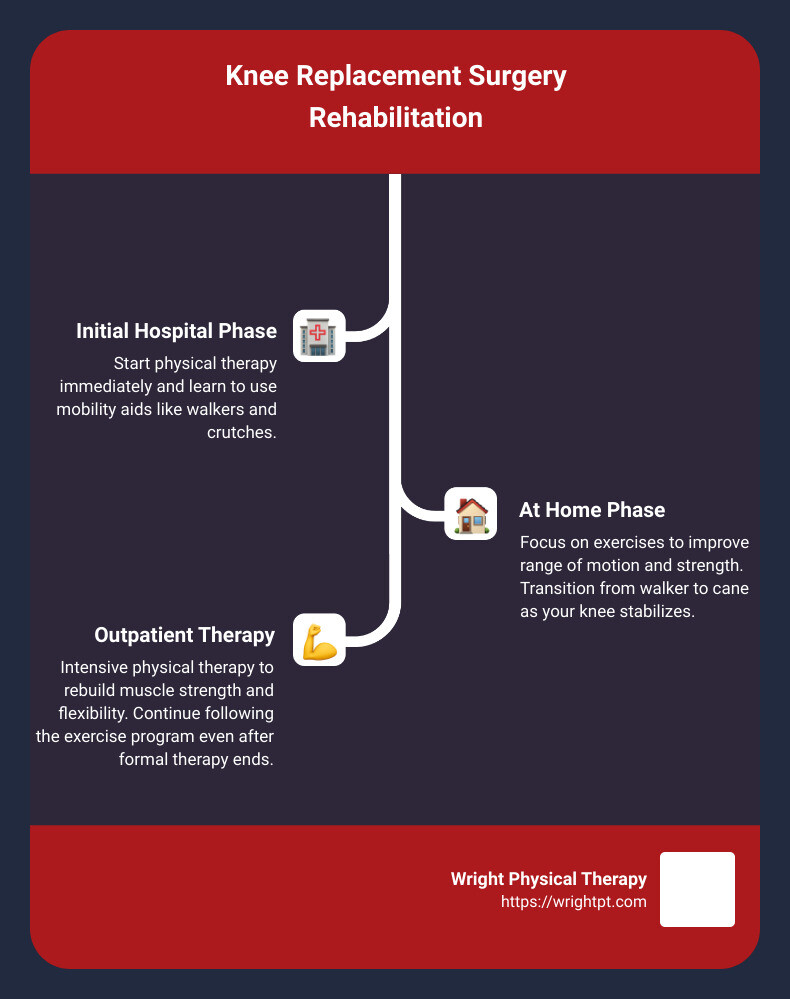
Knee replacement surgery rehabilitation is a crucial journey that begins the moment you wake up from surgery and continues for months. Here are the key points you need to know:
- Initial Hospital Phase (1 to 3 days):
- Start physical therapy immediately.
-
Learn to use mobility aids like walkers and crutches.
-
At Home Phase (2 to 3 weeks):
- Focus on exercises to improve range of motion and strength.
-
Transition from walker to cane as your knee stabilizes.
-
Outpatient Therapy (Up to 4 months):
- Intensive physical therapy to rebuild muscle strength and flexibility.
- Continue following the exercise program even after formal therapy ends.
If you’ve undergone knee replacement surgery, proper rehabilitation is your ticket to quick recovery and a pain-free life. Post-surgery rehab aims to restore movement, strength, and quality of life after knee replacement.
“PT after knee replacement is like a pyramid,” explains HSS physical therapist Vincent Luppino, PT, DPT, OCS. Building a solid foundation of movement and strength is crucial.
At Wright Physical Therapy, we’re committed to guiding you through every step of rehabilitation, ensuring you regain your mobility effectively and safely.
My name is Bryan Wright, and as an expert in high-skilled physical therapy treatments, I am dedicated to helping you transition from surgery to strength. With years of experience in knee replacement surgery rehabilitation, I’m here to make your journey smoother.
The Initial Phase: Hospital Recovery
Early Post-operative Exercises
After knee replacement surgery, your recovery journey starts right away. The day after surgery, you’ll be up on your feet with the help of mobility aids like a walker or crutches. This isn’t just to get you moving—it’s essential for preventing blood clots and improving blood flow to your legs and feet.
Physical therapy begins almost immediately. A physical therapist will guide you through exercises designed to improve movement and strengthen your knee. They will also show you how to get in and out of bed and use the bathroom safely.
Pain management is another critical aspect. You’ll receive medications to manage pain and inflammation, which will help you move more comfortably. Effective pain management is crucial for your participation in physical therapy and overall recovery.

Mobility Aids and Daily Activities
In the hospital, you’ll learn to use mobility aids such as walkers, crutches, or parallel bars. These tools help you start walking short distances, which is vital for your recovery. Nurses and occupational therapists will teach you how to dress, bathe, and use the toilet without putting too much strain on your new knee.
Dressing and Bathing: You’ll learn techniques to dress and bathe independently. For example, using a long-handled reacher can help you put on socks without bending your knee too much.
Toilet Use: Raised toilet seats and grab bars can make using the bathroom easier and safer.
Key Early Exercises
Your physical therapist will introduce you to several exercises to kickstart your recovery. These exercises focus on increasing circulation, preventing blood clots, and strengthening your muscles.
Quadriceps Sets: Tighten your thigh muscle and try to straighten your knee. Hold for 5 to 10 seconds. Repeat about 10 times in a 2-minute period. Rest for one minute, then repeat until your thigh feels tired.
Straight Leg Raises: Tighten your thigh muscle with your knee fully straightened on the bed. Lift your leg several inches and hold for 5 to 10 seconds. Slowly lower it down. Repeat until your thigh feels fatigued.
Ankle Pumps: Move your foot up and down by contracting your calf and shin muscles. Perform this exercise for 2 to 3 minutes, 2 to 3 times an hour.
Knee Straightening: Place a small rolled towel just above your heel so that your heel is not touching the bed. Tighten your thigh and try to fully straighten your knee, holding for 5 to 10 seconds. Repeat until your thigh feels fatigued.
Bed-Supported Knee Bends: Slide your foot toward your buttocks, bending your knee while keeping your heel on the bed. Hold for 5 to 10 seconds, then straighten your leg. Repeat until your leg feels fatigued.
Sitting Supported Knee Bends: While sitting, place your foot behind the heel of your operated knee for support. Slowly bend your knee as far as you can and hold for 5 to 10 seconds. Repeat until your leg feels tired.
Sitting Unsupported Knee Bends: Sit at the bedside or in a chair with your thigh supported. Bend your knee as far as you can until your foot rests on the floor. Slide your upper body forward to increase the knee bend. Hold for 5 to 10 seconds, then straighten your knee fully. Repeat until your leg feels fatigued.
These exercises are designed to get you moving and help your knee regain strength and flexibility. They might feel uncomfortable at first, but they are crucial for a successful recovery. Always follow your therapist’s guidance and don’t push yourself too hard. Slow and steady wins the race.
Next, we’ll explore how to continue your rehabilitation at home, focusing on exercises and activities that will help you regain mobility and strength.
At Home: Continuing Your Rehabilitation
Key Exercises for Home Rehabilitation
After leaving the hospital, your knee replacement surgery rehabilitation continues at home. This phase is crucial for regaining mobility and strength. Here are some key exercises and tips to help you on your journey.
Home Exercises
-
Walking: Start with short walks inside your house, then gradually move outside. Aim for 20 to 30 minutes, two to three times a day. Walking helps prevent scar tissue and increases knee strength.
-
Leg Lifts: Lie on your back, straighten your knee, and tighten your thigh muscles. Lift your leg a few inches off the bed and hold for 5-10 seconds. Lower it slowly. Repeat 10 times, three times a day.
-
Ankle Pumps: While lying down, move your foot back and forth. This strengthens your calf muscles and improves circulation.
-
Short-Arc Quads: Lie on your back with a pillow under your operated leg. Lift your heel off the bed, hold for five seconds, and lower it. Do 10 reps, three times a day.
-
Straight Leg Raises: Lie on your back and raise one leg at a time, holding it in the air for five seconds. Repeat 10 times, three times a day.
Mobility
-
Short Walks: Gradually increase the distance and duration of your walks. Start indoors, then venture outside.
-
Stair Climbing: Initially, use a handrail for support. Lead with your good knee going up and your operated knee going down. “Up with the good, down with the bad.”
Everyday Activities
-
Chores: Slowly resume household chores. Start with light activities and gradually increase the intensity.
-
Self-Care: Continue practicing the techniques for dressing, bathing, and using the toilet that you learned in the hospital.
Pain Management
- Ice and Elevation: If you experience pain or swelling after exercise, elevate your leg and apply ice wrapped in a towel for 20 minutes. Repeat this for about two hours.
Physical Therapy
- Follow-Up: Work with your physical therapist to track your progress and adjust your exercise routine. They will help you safely increase your activity level.
Self-Care
-
Rest: Ensure you get adequate rest to allow your body to heal.
-
Nutrition: Eat a balanced diet to support your recovery.
By consistently performing these exercises and activities, you’ll build strength and improve mobility. The goal is steady progress, not perfection. Always consult your physical therapist if you have any concerns or questions.
Next, we’ll dive into outpatient therapy and advanced exercises to help you achieve full recovery.
Outpatient Therapy: The Road to Full Recovery
Advanced Exercises and Activities
When you transition to outpatient therapy, your focus will shift to more advanced exercises and activities. This phase is crucial for building muscle strength, improving flexibility, and boosting your cardiovascular capacity. Your physical therapist will tailor an exercise program to meet your specific needs and goals.
Muscle Strength
Strengthening the muscles around your knee is key to a successful recovery. One effective exercise is standing knee bends:
- Stand behind a chair or next to a wall for support.
- Slowly bend your knee as far as you can.
- Hold the position for a few seconds, then slowly straighten your knee.
Resistance Exercises
Adding resistance can make your muscles work harder, which helps them get stronger. Here are some tips:
- Ankle Weights: Start with 1- to 2-pound weights around your ankle.
- Elastic Bands: Use these for added resistance during leg lifts or squats.
Exercycling
Riding an exercise bike is excellent for regaining muscle strength and knee mobility. Follow these steps:
- Adjust the seat so your foot just touches the pedal with your knee almost straight.
- Start by pedaling backwards.
- Once comfortable, pedal forward.
- Gradually increase the tension as you get stronger.
Cardiovascular Capacity
Cardio exercises help with overall fitness and knee recovery. Options include:
- Walking on a Treadmill: Stable surface reduces fall risk.
- Swimming: Low-impact but effective.
- Indoor Cycling: Great for controlled cardio workouts.
Pain Management
Managing pain is crucial for effective rehab. If you experience pain or swelling after exercise:
- Elevate Your Leg: Prop it up to reduce swelling.
- Apply Ice: Use ice wrapped in a towel for 20 minutes, then remove it for 20 minutes. Repeat this for about 2 hours.
Swelling Management
Swelling can slow your recovery. To manage it:
- Ankle Pumps: Move your foot up and down to improve blood flow.
- Compression Stockings: These can help reduce swelling.
Long-Term Recovery
Your journey to full recovery takes time. Be patient and consistent with your exercises. Most patients can expect significant improvements within 3 to 6 months, but full recovery can take up to a year.
Stay Committed
- Follow Your Plan: Stick to the exercise program prescribed by your therapist.
- Communicate: Keep your therapist informed about your progress and any issues.
- Stay Positive: Recovery is a marathon, not a sprint.
By following these advanced exercises and activities, you’ll be well on your way to a complete and successful recovery.
Next, we’ll tackle some frequently asked questions about knee replacement surgery rehabilitation.
Frequently Asked Questions about Knee Replacement Surgery Rehabilitation
How long is rehab after knee replacement?
Rehabilitation after knee replacement surgery typically lasts about 12 weeks. It’s a structured process designed to help you regain strength and mobility.
- First 3 Weeks: Most people can walk without an assistive device like a walker or cane.
- 4-6 Weeks: Many patients can start driving again, especially if their left leg was operated on.
Everyone’s recovery timeline is unique, so follow your healthcare team’s advice.
What is the hardest part of knee replacement recovery?
The hardest part of knee replacement recovery is often the first six weeks. This period is crucial for regaining mobility and managing pain and inflammation.
- First Week: This is usually the toughest. You’ll experience significant pain and swelling. Physical therapy starts immediately to help you get moving.
- Weeks 2-6: Pain and inflammation gradually decrease, but daily exercises and physical therapy are essential to continue progress.
Stick to your rehab plan and communicate with your healthcare team to make this period as smooth as possible.
How long does it take to walk normally after knee replacement?
Most people can start walking normally within 3 to 6 weeks after surgery. Initially, you may need an assistive device, but your goal is to achieve a normal walking pattern as soon as possible.
- 3 Weeks: You might walk without a cane or walker.
- 6 Weeks: Many patients can walk and stand for more extended periods without assistance.
Consistency with your rehabilitation exercises is key to regaining a normal walking pattern quickly.
By understanding these key aspects of knee replacement surgery rehabilitation, you can set realistic expectations and stay motivated throughout your recovery journey.
Next, we’ll dive into the conclusion and summarize the importance of following your rehab plan and the long-term benefits of knee replacement surgery.
Conclusion
Recovering from knee replacement surgery is a journey that requires patience, commitment, and the right support. The rehabilitation process is critical in ensuring you regain strength, flexibility, and the ability to perform everyday activities without pain.
Following your rehab plan is essential. It’s not just about doing exercises; it’s about doing the right exercises at the right times. This structured approach helps in gradually improving your range of motion, rebuilding muscle strength, and preparing you to return to your favorite activities. As Vincent Luppino from HSS points out, the rehab process is like building a pyramid: each phase builds on the previous one, leading to full recovery.
At Wright Physical Therapy, we understand the challenges and concerns you might have during this period. Our expert physical therapists are here to guide you through every step of your rehabilitation journey. From the initial hospital recovery phase to advanced outpatient therapy, we tailor our programs to meet your specific needs and goals.
Long-term benefits of a well-followed rehab plan are significant. According to the American Association of Hip and Knee Surgeons (AAHKS), it can take up to a year for your knee to become as strong and resilient as possible. However, with consistent effort and the right guidance, you can expect to return to most of your normal activities within three to six months.
By committing to your rehabilitation, you are investing in a future with less pain, better mobility, and a higher quality of life. Each step you take brings you closer to your goal of a fully functional knee.
For personalized support and expert guidance on your knee replacement surgery rehabilitation, visit our Post-Surgical Rehabilitation page and schedule an appointment with Wright Physical Therapy today.
Consistency and dedication in following your rehab plan will lead to a successful recovery and a return to the activities you love. Stay motivated, and lean on us for support and expertise.