
Where your knee hurts is the best first clue to why it hurts. Pain in front of the kneecap, just below it, on the outside, or on the inside each points toward a different set of causes, and most knee pain that starts without an injury improves with the right exercise-based care. Location narrows the list, but testing how your knee responds to movement is what confirms the cause, and sometimes the source is not in the knee at all.
Kevin Cherry, PT, DPT, Cert MDT, OCS, walks through the knee in our video, Let’s Demystify the Knee.
What does the location of your knee pain tell you?
If your knee started hurting without a fall, a twist, or a blow, where you feel it is one of the most useful things you can tell a physical therapist. Each area of the knee has a short list of usual suspects.
| Where it hurts | What it often feels like | What we commonly find |
| In front of or behind the kneecap | An ache with stairs (especially going down), squatting, kneeling, or sitting for a long time | Patellofemoral pain: an irritated kneecap joint taking more load than it is ready for |
| Just below the kneecap | Pinpoint pain on the tendon, worse with jumping, landing, or deep squats | Patellar tendinopathy, often called jumper’s knee |
| Just above the kneecap | Pain at the top edge of the kneecap with squats, lunges, or stairs | Quadriceps tendinopathy |
| Outside of the knee | Sharp or burning pain that builds at a predictable point in a run or ride | Iliotibial (IT) band syndrome |
| Inside of the knee | An ache along the inner joint line or just below it, sometimes with catching | Arthritis on the inner side of the joint, a meniscus problem, irritated tendons just below the joint line, a plica, or an MCL sprain after a twist or hit |
| Back of the knee | Tightness or fullness behind the knee, pain with full bending or straightening | Hamstring or calf tendon irritation, or swelling coming from inside the joint |
| The whole knee, stiff and achy | Stiff first thing in the morning or after sitting, loosens as you move, aches after a long day | Knee osteoarthritis, a common cause of knee pain past middle age |
These are patterns, not diagnoses. Two people with pain in the same spot can have different problems, and the same problem can show up in more than one spot. That is why the next step is testing, not guessing. If stiffness and aching across the whole knee sound familiar, our page on physical therapy for arthritis covers that side in more depth.
Kneecap and IT band pain are not what you may have heard
Front-of-knee pain used to be blamed almost entirely on a kneecap that tracks poorly. Current research describes it as multifactorial: how much load the joint is taking, how well the hip and thigh muscles control it, and how quickly activity ramped up all play a part. Each of those can be changed.
IT band pain was long explained as the band rubbing back and forth over bone. Anatomical studies have not supported that. It is better explained by compression of sensitive tissue under the band at the outer knee, which is why treatment focuses on hip control and training load. Runners can pair that with a running and gait analysis.
Can knee pain come from your back?
Yes. Sometimes a painful knee is the symptom, not the source. Nerves from the low back supply the thigh and knee, so a problem in the spine can produce knee pain with little or no back pain.
In a McKenzie Method (Mechanical Diagnosis and Therapy) evaluation, the low back is screened before the knee for exactly this reason. In a 2021 study of patients whose only complaint was arm or leg pain, McKenzie-trained clinicians found a spinal source in close to half of them, and those patients did better when the spine was treated. A smaller study of people with ongoing knee pain found the same pattern.
A knee that keeps failing to respond to knee treatment is the classic sign the source has been missed. If your knee pain comes with back stiffness, or changes when you sit, bend, or stand for a while, tell your physical therapist.
How does a physical therapist find the real cause of knee pain?
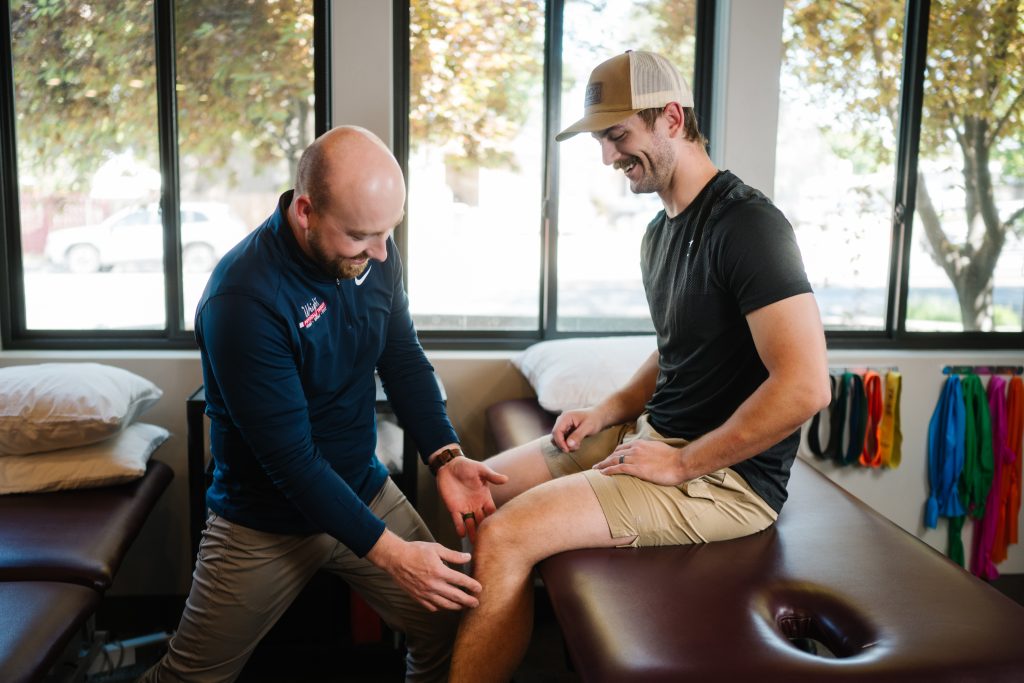
Your evaluation starts with your story: where it hurts, what makes it worse, what eases it, and how it started. Then your physical therapist tests how the knee, hip, and back respond to movement and load, including squatting, stepping, bending and straightening, and often repeated movements of the back and knee.
The response to testing is the diagnosis. If a movement reduces your pain or restores motion, that movement usually becomes the first thing you do, so evaluation and treatment happen in the same visit. Most patients notice a difference in pain or motion before they leave, and they go home with a plan built around what their own knee responded to, not a generic handout.
What are the steps to getting a knee better?
“The exact source does matter, but getting a knee better usually comes back down to just a few basic principles.”
Kevin Cherry, PT, DPT, Cert MDT, OCS
Those principles hold for almost every knee. What the source changes is where you start, which movements you use, and how fast you progress.
- Calm it down. Kevin calls this “stop poking the bear.” Cut back the activities that flare the knee long enough for it to settle, without stopping movement altogether.
- Restore motion. Once the irritation settles, get back full bending and straightening. A knee that cannot fully bend or straighten changes how you walk, squat, and climb stairs.
- Build strength and control. Strengthen the quadriceps and calf, and build control up through the hip. For front-of-knee pain, international experts recommend combining hip and knee strengthening over knee exercises alone. Our post on tight hips explains why the hip matters.
- Reintroduce impact. Return gradually to running, jumping, sport, or long days on your feet, on a progression your knee has earned rather than a date on the calendar.
When is knee pain an emergency?
Call 911 or go to the emergency room if:
- You cannot put weight on the leg after a fall, twist, or blow
- The knee looks deformed or out of place
- You have chest pain or sudden shortness of breath along with a swollen or painful calf
Call your physician or an urgent care the same day if:
- The knee is hot, red, and swollen, especially with a fever or feeling unwell
- Your calf is swollen, warm, or tender
- The knee swelled up quickly after a pop or twist
- Pain wakes you at night no matter how you position the leg
Book an evaluation soon if the knee locks and will not fully straighten, gives way more than once, or you feel numbness or tingling below the knee.
Common questions about knee pain
Is it safe to keep walking or running with knee pain?
Often, yes, if you keep it within limits. A practical guide physical therapists use: pain during activity should stay at a moderate level, around 5 out of 10 or lower, and it should settle back to where it started by the next morning. If you start limping, the pain spikes sharply, or the knee is more swollen or painful the next day, scale back and let it calm down before building up again.
Should I stop exercising if my knee hurts?
Rarely. Complete rest lets the knee and the muscles around it lose capacity, which can make the next flare easier to trigger. Modify instead: cut back the activity that aggravates the knee, keep moving in ways it tolerates, and keep strengthening. A physical therapist can show you which movements your knee tolerates right now.
Should I try physical therapy before surgery or an injection?
For most knee pain that starts without an injury, clinical guidelines for patellofemoral pain and knee osteoarthritis recommend exercise-based physical therapy as a first step. If surgery or an injection has already been suggested, an evaluation shows how your knee responds to loading, which is useful information to bring back to your surgeon or physician. We treat the musculoskeletal side of knee pain and work alongside your physician or surgeon when you have one.
Do I need a referral to see a physical therapist for knee pain?
No. Idaho and Utah both allow you to see a physical therapist directly, without a physician’s referral. Some insurance plans, including federal and state programs such as Medicare, Medicaid, and Tricare, have their own requirements, so check your plan or call us at 208-969-9945.
Will insurance cover physical therapy for knee pain?
Most health plans include physical therapy benefits, and knee pain care falls under them. Copays, deductibles, and visit limits vary by plan. See our insurance information page or call 208-969-9945 and we can help you check your benefits.
Get to the root of your knee pain
Don’t wait to feel better. No referral needed.
Book an evaluation at any Wright PT clinic across the Treasure Valley, Magic Valley, Mini-Cassia, eastern Idaho, and Logan, Utah. Your physical therapist will test how your knee, hip, and back respond to movement, start treatment with what helps, and build a plan around the cause so you can move freely and live fully.
Schedule your knee evaluation online or call 208-969-9945. Learn more about our knee pain treatment.
Written by Kevin Cherry, PT, DPT, Cert MDT, OCS
Edited and clinically reviewed by Bryan Wright, PT, DPT, Cert MDT, OCS
Last reviewed October 4, 2026